By Simply Dents | Poway | 951.378.6662
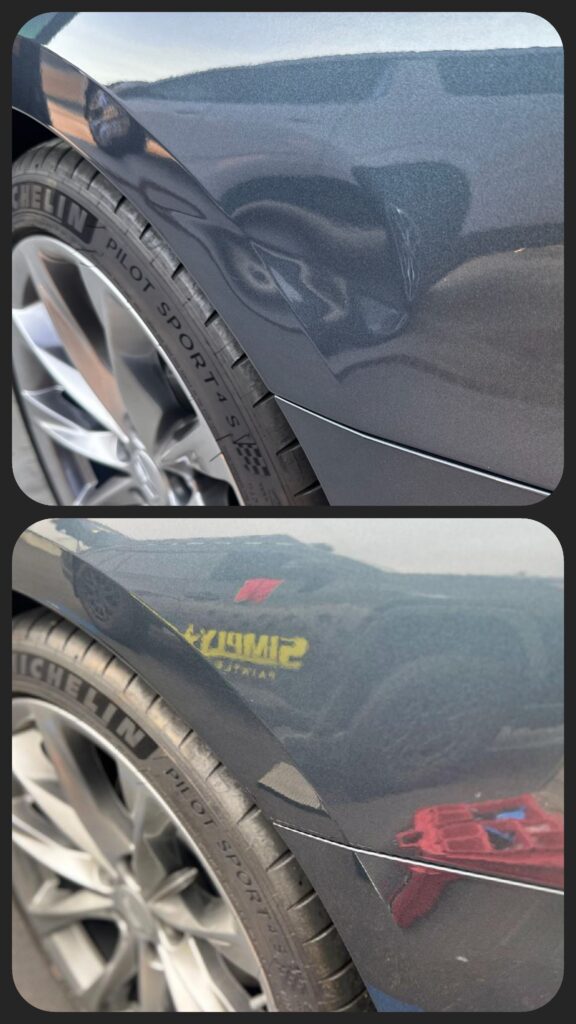
A small door ding can be surprisingly noticeable, especially when the rest of your vehicle is clean and well maintained. Whether the damage happened in a crowded parking lot, from a shopping cart, or during another minor incident, you may have an alternative to conventional bodywork. Simply Dents at 951.378.6662 provides paintless dent repair in Poway for qualifying dents and dings, using specialized techniques designed to restore damaged panels while preserving the vehicle’s existing painted finish.
🚗 Why Are Door Dings So Noticeable?
A door ding might only measure a few inches across, but its location can make it stand out.
Modern vehicle panels are designed with smooth contours and carefully defined body lines. Light reflects evenly across those surfaces when the panel is undamaged. Once a dent interrupts that surface, the reflection changes and can make even relatively small damage easy to spot.
Dark, glossy, and freshly detailed vehicles may make these imperfections particularly noticeable.
The good news is that many minor automotive dents don’t automatically require sanding, body filler, primer, and new paint.
Depending on the condition of the panel, paintless dent repair may provide another option.
🔧 How Does Paintless Dent Repair Work?
Paintless dent repair, commonly abbreviated as PDR, focuses on reshaping the existing vehicle panel rather than covering the damage with filler and refinishing the area.
The technician carefully evaluates the dent to understand how the metal moved during the impact.
Specialized tools and techniques can then be used to gradually manipulate the affected area toward its original shape. Depending on the dent, access may be available from behind the panel or another technique may be appropriate.
The process requires precision. Moving one section of metal can affect surrounding areas, so corrections are typically performed gradually.
When successful, the result is achieved without repainting the repaired area.
🎨 Keeping the Original Paint Is a Major PDR Advantage
One of the defining characteristics of paintless dent removal is that it works with the vehicle’s existing finish.
If the original paint remains intact and flexible enough for the repair, the damaged panel may be restored without conventional refinishing.
That eliminates the need to match newly applied paint to the vehicle’s existing color.
Automotive paint can change subtly over time because of age, sunlight, environmental exposure, and other factors. Modern refinishing techniques can produce excellent results, but avoiding unnecessary repainting altogether can be attractive when the existing finish hasn’t been damaged.
For suitable dents, PDR keeps the repair focused on reshaping the panel itself.
🛒 Parking Lots Are Prime Territory for Door Dings
Few things are more frustrating than parking a clean vehicle and returning to find a fresh dent in the door.
Crowded parking spaces place vehicles close together, and a neighboring door doesn’t need to strike your car particularly hard to leave a visible mark.
Shopping carts are another common source of parking lot dents.
Wind, sloped pavement, or an unattended cart can send it rolling into a fender, quarter panel, or door.
Damage from these incidents varies widely. Some impacts leave only a shallow depression, while others may create a sharper dent, crease, or paint damage.
When the finish remains intact, having the area evaluated for PDR can help determine whether conventional body repair can be avoided.
📏 Size Isn’t the Only Factor That Determines Repairability
It’s tempting to judge a dent solely by its diameter.
In reality, PDR repairability depends on several characteristics.
A relatively large but shallow dent in an accessible section of a panel may sometimes present a better repair opportunity than a much smaller but extremely sharp dent.
Technicians also consider where the dent is located, whether the metal has stretched, whether the paint is damaged, and whether the backside of the panel can be accessed when necessary.
Body lines and panel edges can add complexity as well.
Because these variables aren’t always obvious from looking at a dent, a professional evaluation provides much more useful information than simply measuring the damaged area.
🛠️ Body-Line Dents Require Precision
Look closely at a modern vehicle and you’ll notice numerous sculpted lines running through the doors, fenders, and quarter panels.
These aren’t accidental. Body lines are important design elements that help give a vehicle its distinctive appearance.
A dent directly on one of these lines can therefore be particularly noticeable.
Body-line dent repair may also be more challenging because the metal has been displaced in an area with a defined contour.
PDR techniques can sometimes be used on this type of damage, depending on severity and other factors.
Restoring a defined contour requires careful attention because the repaired area needs to flow naturally into the surrounding panel.
🔍 Lighting Plays an Important Role in Dent Repair
Professional PDR isn’t performed by simply looking at the panel under ordinary room lighting.
Specialized lighting and reflection systems can help reveal subtle highs and lows in the damaged surface.
These visual references allow the technician to understand the dent’s shape more precisely and monitor changes as the metal is manipulated.
A panel that appears smooth from one angle may still reveal distortion when viewed through reflected lines.
This is one reason professional paintless dent repair requires both specialized equipment and developed technical skill.
The technician isn’t only removing an obvious depression. The goal is to restore the panel’s contours as accurately as practical.
💰 PDR Can Avoid Unnecessary Refinishing Steps
Traditional automotive body repair has an important role, particularly when damage includes broken paint, severe deformation, or collision damage that isn’t appropriate for PDR.
However, minor dents don’t always require that level of repair.
When PDR is suitable, the process can avoid steps such as body filler application, sanding, priming, painting, and clear-coat application.
That makes paintless dent removal a focused approach to correcting qualifying cosmetic damage.
The exact cost and repair time depend on the dent itself. Location, severity, accessibility, vehicle construction, and the number of dents can all affect the job.
An inspection is therefore the appropriate way to determine what a particular repair involves.
⏱️ Minor Dent Repair May Be More Convenient Than You Expect
Many vehicle owners postpone cosmetic repairs because they assume their car will require extensive bodywork.
For suitable damage, PDR may simplify the process because conventional refinishing isn’t required.
A single accessible door ding is obviously different from dozens of dents caused by a severe hailstorm, so repair times can vary significantly.
The important point is that a small dent doesn’t necessarily mean a complicated traditional body repair.
Having the damage evaluated can provide a clearer understanding of the available dent repair options.
You may discover that the annoying dent you’ve been looking at every day is a good candidate for paintless repair.
✨ Improve the Appearance of a Well-Maintained Vehicle
Small dents tend to become especially frustrating when a vehicle is otherwise in excellent condition.
You may regularly wash and detail the car, keep the wheels clean, and maintain the interior, yet your eye still goes directly to that one dent every time you walk toward the vehicle.
Addressing minor cosmetic dents can restore a cleaner overall appearance.
This can be worthwhile simply because you enjoy keeping your vehicle looking good.
Cosmetic dent repair can also be considered when preparing a vehicle for photographs, a special event, sale, or trade-in.
Removing distracting dents allows the overall condition of the vehicle to make the stronger first impression.
💵 Consider PDR Before Selling or Trading Your Vehicle
Exterior appearance is one of the first things someone notices when evaluating a used vehicle.
Visible door dings and dents can draw attention immediately, even when the vehicle has been mechanically maintained.
Before selling or trading your car, it may be worthwhile to evaluate obvious cosmetic damage.
That doesn’t mean every imperfection must be repaired. The decision depends on the vehicle, severity of the damage, and your individual circumstances.
However, understanding whether a visible dent qualifies for paintless dent repair gives you another option when preparing the vehicle.
Improving prominent cosmetic damage can help the exterior present as cleanly as possible.
⚠️ When Might Traditional Body Repair Be Necessary?
PDR is a valuable technique, but it isn’t appropriate for every type of automotive body damage.
If an impact has cracked, chipped, or removed paint, refinishing may be necessary.
Severely stretched metal, sharp collision damage, inaccessible areas, or damage involving structural components can also require a different repair approach.
That’s why responsible dent evaluation is important.
The objective shouldn’t be to use PDR on every vehicle regardless of the circumstances. It should be to determine whether paintless dent removal is suitable for the specific damage.
When it is, PDR can offer significant advantages. When it isn’t, another repair method may be more appropriate.
📸 Don’t Assume You Have to Live With Small Dents
Minor dents are easy to postpone because they usually don’t prevent the vehicle from being driven.
Weeks turn into months, and eventually you may simply become accustomed to seeing the damage.
But if the dent bothers you every time sunlight reflects across the panel, consider having it inspected.
A professional can evaluate the dent’s shape, depth, location, paint condition, and accessibility to determine whether PDR is possible.
You don’t have to decide based on guesswork.
An evaluation can tell you whether door ding removal or another PDR technique may be suitable for restoring the affected panel.
📍 Paintless Dent Repair in Poway
A parking lot ding or minor dent doesn’t necessarily mean your vehicle needs traditional sanding, fillers, and repainting. When the paint remains intact and the damage is suitable, PDR can provide a precise way to restore the panel while preserving the existing finish. For paintless dent repair in Poway, contact Simply Dents at 951.378.6662 to have your door dings and minor dents evaluated and find out whether paintless repair is right for your vehicle.