By Simply Dents | Poway | 951.378.6662
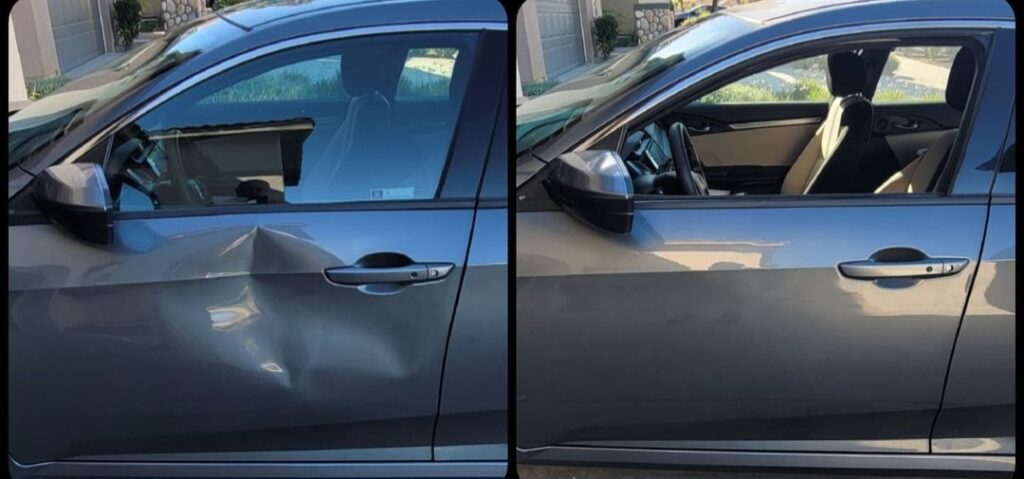
You can park carefully, leave plenty of room around your vehicle, and still return to find an unwanted dent or door ding. Shopping carts, neighboring car doors, and everyday parking lot mishaps can leave noticeable damage on an otherwise beautiful vehicle. Simply Dents at 951.378.6662 provides paintless dent repair in Poway, helping vehicle owners restore qualifying dents and dings without the sanding, body filler, and repainting associated with traditional body repair.
🛒 Why Are Parking Lot Dents So Common?
Parking lots put vehicles in close proximity to one another, making minor body damage difficult to avoid completely.
A neighboring driver may open a door too far. A passenger may lose control of a door on a windy day. An unattended shopping cart can roll across a parking lot and strike a parked vehicle.
Even relatively light contact can leave behind a visible door ding or minor dent.
Because modern vehicle panels have carefully designed curves and body lines, a small imperfection can become surprisingly noticeable when light reflects across the damaged area.
Fortunately, a minor parking lot incident doesn’t automatically mean the affected panel needs conventional bodywork.
🔧 What Is Paintless Dent Repair?
Paintless dent repair, also commonly called paintless dent removal or PDR, is a specialized technique for correcting certain automotive dents while preserving the existing painted finish.
Rather than covering the damaged area with filler and applying new paint, PDR focuses on carefully restoring the shape of the existing panel.
Specialized tools and techniques allow a trained technician to manipulate the damaged metal in a controlled manner.
The exact technique depends on the dent’s location, shape, depth, and accessibility.
When the damage is appropriate for the process, PDR can restore the panel without the refinishing procedures typically associated with conventional automotive body repair.
🎨 Keep Your Vehicle’s Existing Finish
Preserving the existing paint is one of the biggest reasons vehicle owners consider paintless dent removal.
Traditional repair techniques may require sanding the affected area, applying filler, preparing the surface, and refinishing the panel.
Those procedures are necessary for many types of body damage, particularly when paint has been compromised.
But when a dent hasn’t cracked or chipped the finish, repainting may not always be necessary.
PDR works with the panel and finish already on the vehicle.
For owners who want to maintain their vehicle’s existing exterior finish whenever practical, that can be a significant advantage.
🚪 Door Dings Can Happen Almost Anywhere
The grocery store isn’t the only place where vehicles pick up door dings.
Restaurant parking lots, shopping centers, office parking structures, schools, apartment complexes, gyms, and crowded public parking areas can all create opportunities for accidental contact.
Sometimes the person responsible doesn’t even realize they’ve caused damage.
You may simply return to your vehicle and notice a new indentation along the door or quarter panel.
While a parking lot door ding may not affect how the vehicle drives, that doesn’t make it any less frustrating.
If the damage qualifies for PDR, you may be able to restore the panel without resorting to conventional refinishing.
🔍 What Makes a Dent Suitable for PDR?
Not every dent can be repaired using the same technique.
Several factors determine whether PDR dent repair is appropriate.
The condition of the paint is important. The size and depth of the dent matter, but those aren’t the only considerations.
Technicians also evaluate where the dent is located, whether the metal appears stretched, how the impact affected surrounding contours, and whether the damaged area can be accessed appropriately.
A shallow dent in an open section of a door may present different challenges than a sharp ding located directly on a reinforced body line.
That’s why professional evaluation is the best way to determine whether a particular dent is suitable for paintless repair.
📏 A Small Dent Isn’t Always a Simple Dent
It might seem logical that a smaller dent would always be easier to repair than a larger one.
Automotive panels don’t necessarily work that way.
A broad, shallow dent may sometimes respond differently than a tiny but extremely sharp impact.
Location can also have a major influence.
A dent near the center of an accessible panel may provide different repair options than one near an edge, brace, or complex contour.
Professional minor dent repair involves evaluating the complete shape of the damage rather than simply measuring its diameter.
The goal is to understand how the metal moved and determine how it can be carefully returned toward its proper position.
✨ Body Lines Make Dents More Noticeable
Many modern vehicles feature prominent body lines running through the doors, fenders, and quarter panels.
These contours create character and contribute to the vehicle’s overall design.
Unfortunately, a dent that crosses one of these lines can become particularly visible.
Light no longer follows the intended contour smoothly, making the damaged section stand out.
Body-line dent repair can require additional precision because the technician isn’t simply restoring a relatively flat area. The defined contour also needs to be recreated as accurately as practical.
Depending on the severity and condition of the damage, some body-line dents may still qualify for PDR.
🛠️ Why Specialized PDR Tools Matter
Paintless dent repair requires much more than simply pushing on the backside of a dent.
Professional technicians use specialized tools designed to reach and manipulate different areas of automotive panels.
Controlled pressure is important because excessive movement can create high spots or additional distortion.
Specialized lighting and reflection systems may also be used to make subtle variations in the panel easier to see.
These visual references help technicians identify the precise shape of the dent and monitor changes throughout the repair.
Quality professional dent removal requires patience, control, and an understanding of how automotive sheet metal responds to manipulation.
💰 Avoiding Unnecessary Bodywork Can Be Valuable
Conventional body repair remains essential for damage that requires paint, filler, panel replacement, or other extensive work.
However, using those procedures when a dent qualifies for PDR may introduce repair steps that aren’t necessary.
Paintless dent repair focuses directly on restoring the damaged metal.
When repainting isn’t required, the repair avoids conventional paint preparation, color application, clear coating, and related refinishing procedures.
This can make PDR an attractive option for minor cosmetic damage.
The cost of an individual repair still depends on several factors, including dent size, location, depth, accessibility, and complexity.
An evaluation provides the most useful information for a specific vehicle.
⏱️ Don’t Assume a Small Dent Means a Long Body-Shop Visit
Some drivers continue living with dents because they expect any body repair to become a major project.
Paintless repair can offer a different experience when the damage is suitable.
Because the process doesn’t require conventional painting and refinishing, certain repairs can involve fewer stages.
The amount of time needed still depends on the individual dent. Accessibility and complexity can make two apparently similar dents very different jobs.
Rather than assuming the damage will be inconvenient to repair, consider having it evaluated.
You may discover that door ding removal is more straightforward than expected.
💵 Think About Dents Before Selling Your Vehicle
When someone looks at a used vehicle, exterior condition creates an immediate impression.
A few noticeable dents may attract attention before a prospective buyer considers the interior, maintenance history, or other positive qualities.
If you’re planning to sell your vehicle, correcting prominent cosmetic damage may help it present more cleanly.
The same consideration can apply before a trade-in.
Whether a particular repair makes sense depends on the vehicle and your circumstances, but obtaining a paintless dent repair evaluation can help you understand your options.
You can then decide whether correcting the damage makes sense before presenting the vehicle to potential buyers or a dealership.
🧽 Make Your Detailing Efforts Stand Out
Washing, waxing, and detailing can make a vehicle look fantastic—until sunlight highlights a dent in the middle of the door.
Sometimes exterior imperfections become even more noticeable after a thorough detail because the surrounding paint looks so clean and reflective.
If you put time into maintaining your vehicle’s appearance, correcting qualifying dents can complement those efforts.
Cosmetic dent removal restores the shape of affected panels so the exterior can look smoother and more consistent.
For enthusiasts and everyday drivers alike, eliminating an annoying dent can make the entire vehicle feel better maintained.
🚘 Don’t Wait for More Dents to Accumulate
It’s easy to dismiss the first small ding.
Then another appears on the passenger door. Months later, a shopping cart leaves a dent on a fender.
Eventually, several minor imperfections can significantly change the overall appearance of the vehicle.
You don’t necessarily need to wait until multiple dents accumulate before exploring repair options.
Having minor vehicle dents evaluated as they occur can help you understand which ones are suitable for paintless repair.
It also prevents that first frustrating ding from becoming something you stare at every time you approach your car.
📍 Paintless Dent Repair in Poway
Parking lot dents and door dings may be common, but you don’t necessarily have to accept them as permanent additions to your vehicle. When the paint remains intact and the damage qualifies for PDR, specialized repair techniques can restore the affected panel without traditional sanding, fillers, or repainting. For paintless dent repair in Poway, contact Simply Dents at 951.378.6662 to have your dents evaluated and find out whether PDR can restore the clean appearance of your vehicle.