By Simply Dents | Poway | 951.378.6662

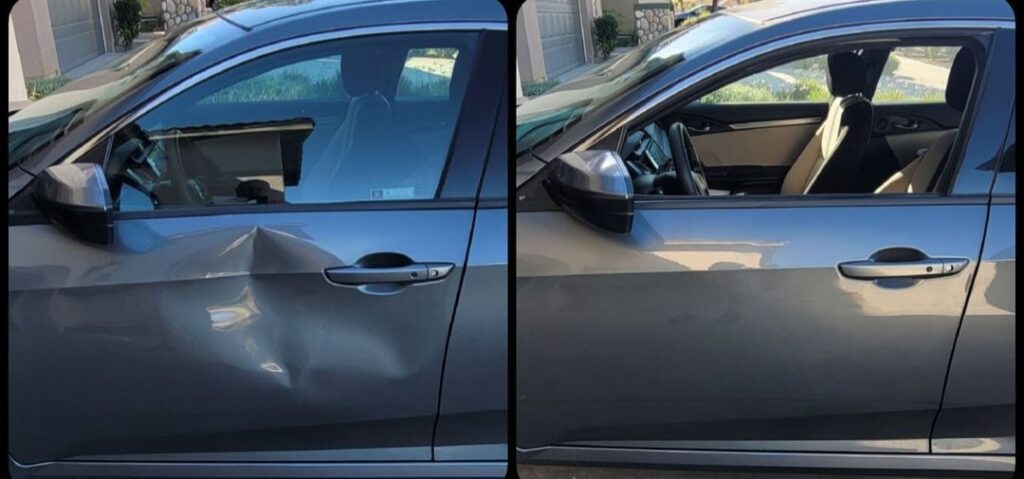
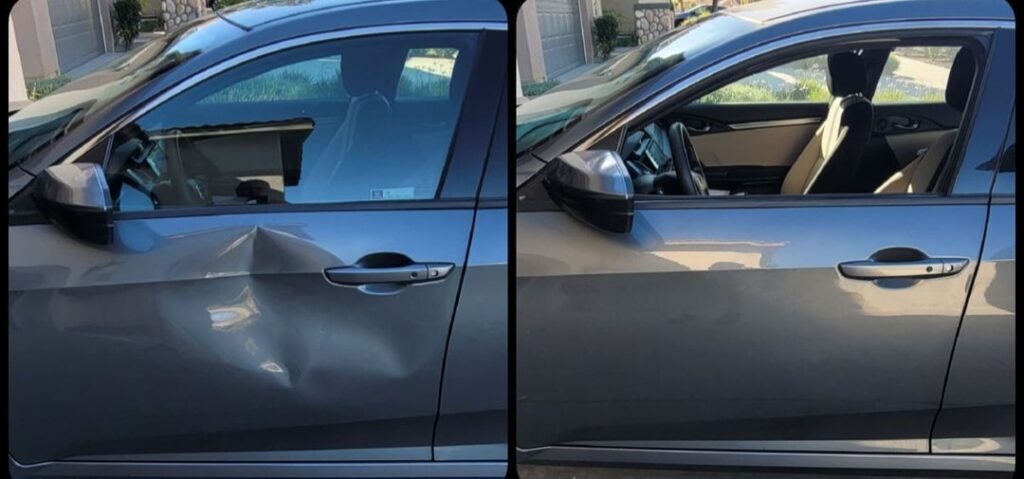
Finding a dent in your vehicle does not always mean you need body filler, sanding, primer, or new paint. Many door dings, hail dents, creases, and other forms of cosmetic damage can be corrected through paintless dent repair, commonly known as PDR.
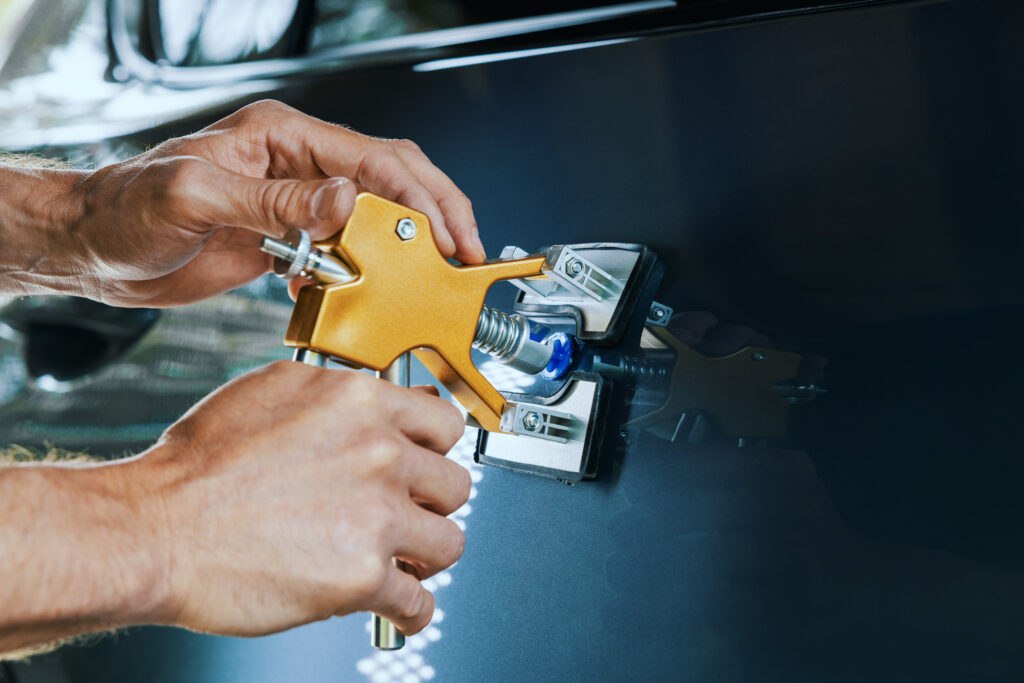
PDR uses specialized tools and carefully controlled pressure to return damaged metal to its original shape. When the factory finish remains intact and the panel has not been damaged beyond recovery, the process can restore the vehicle without conventional refinishing.
Whether a dent qualifies depends on much more than its diameter. Its depth, location, shape, paint condition, panel material, accessibility, and amount of metal stretching all influence what can be achieved.
To find out whether your dent can be repaired without paint, text clear photos to Simply Dents in Poway at 951.378.6662.
🔍 What Makes a Dent Suitable for Paintless Repair?
The most important requirement for paintless dent removal is generally an intact, flexible paint finish. PDR reshapes the metal beneath the finish, so the paint must be capable of moving with the panel without cracking or separating.
A dent may be a good PDR candidate when:
- The original paint is intact.
- The metal is not torn or punctured.
- The panel has not been severely crushed.
- The metal has not stretched beyond recovery.
- A technician can access the damage with suitable tools.
- The panel has not been compromised by extensive previous bodywork.
- The damage is cosmetic rather than structural.
The technician must evaluate the complete damaged area, not just its deepest point. Many dents create surrounding crowns, tension, and subtle distortion that must also be corrected.
1. 🚪 Door Dings
Door dings are among the most common types of damage repaired through PDR. They frequently occur when another vehicle door, shopping cart, bicycle, or similar object contacts the side of a parked car.
A typical door ding is relatively small and leaves the paint intact. If the metal has not been sharply creased or severely stretched, an experienced technician can often restore the panel without repainting it.
Several factors affect the repair:
- Whether the ding crosses a body line
- Its distance from the panel edge
- Internal braces behind the dent
- The panel’s material
- The depth of the impact
- Previous paintwork
Even a small ding can be challenging when it sits directly over a reinforcement brace. Depending on the location, the technician may use tools from behind the panel or an exterior glue-pulling process.
2. 🛒 Shopping-Cart Dents
A runaway shopping cart can create a rounded dent in a door, fender, or quarter panel. These dents often have intact paint and smooth edges, making many of them excellent candidates for paintless dent repair.
Repairability depends on how hard the cart struck the vehicle and whether a sharp corner caused the impact. A broad, shallow dent is usually more favorable than a small, deep puncture-shaped dent.
Shopping-cart damage should be evaluated promptly. Leaving a visible dent may not create an immediate mechanical problem, but it can reduce the vehicle’s appearance, trade-in appeal, and resale presentation.
3. 🌨️ Hail Dents
PDR is widely used to repair automotive hail damage. Hailstones can create dozens or hundreds of small dents across a vehicle while leaving the factory paint intact.
Commonly affected panels include:
- Hood
- Roof
- Trunk lid
- Fenders
- Quarter panels
- Doors
- Roof rails
Specialized lighting helps the technician identify dents that are difficult to see under ordinary conditions. Each depression is then repaired individually.
Paintless repair can prevent the need to repaint several panels, helping preserve the vehicle’s factory finish. Hail damage involving cracked paint, broken trim, shattered glass, or severely stretched metal may require additional repair methods.
Insurance may cover hail damage under a vehicle’s comprehensive policy, subject to its terms and deductible.
4. ➖ Shallow Creases
A crease forms when an object drags across or presses into a panel, producing an elongated line rather than a round depression. Creases are often more complicated than standard door dings because the metal has been displaced across a longer area.
Many creases can still be repaired without paint when:
- The paint remains intact.
- The metal has not folded sharply.
- The crease is reasonably accessible.
- The panel has not been torn.
- The damage does not include extreme stretching.
Repairing a crease requires carefully releasing tension along its entire length. The technician gradually works the metal rather than concentrating only on the deepest point.
Text photos to Simply Dents at 951.378.6662 for an initial assessment of crease damage.
5. 📐 Body-Line Dents
Modern vehicles use sculpted character lines to add strength and visual definition to doors, fenders, quarter panels, and truck bedsides. A dent directly on one of these lines can be challenging because the metal is already shaped under tension.
Body-line dents were once considered poor PDR candidates, but advanced tools and techniques allow experienced technicians to repair many of them successfully.
The result depends on:
- The sharpness of the original body line
- The depth of the dent
- Paint condition
- Panel access
- Steel or aluminum construction
- The amount of stretching
These repairs require a clear understanding of the panel’s original contour. Improper pressure can flatten or distort the body line instead of restoring it.
6. 🅿️ Minor Parking-Lot Dents
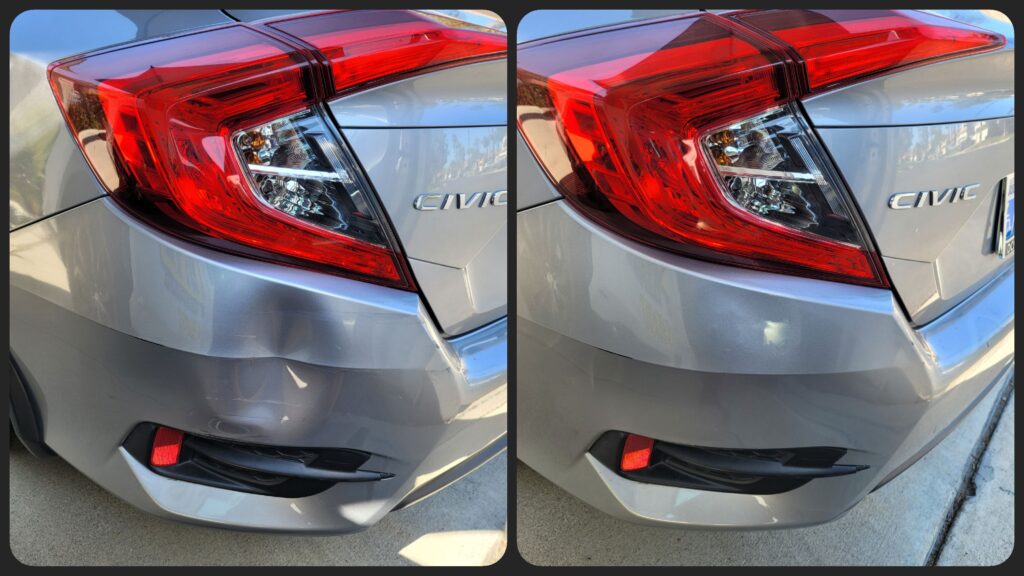
Parking lots produce many forms of cosmetic vehicle damage. A nearby car, cart, post, or other object can leave dents in doors, bumpers, fenders, and quarter panels.
PDR may be appropriate when the impact caused a depression but did not:
- Break the paint
- Tear the metal
- Damage a structural component
- Severely crush the panel
- Destroy mounting points
- Break nearby trim
Minor parking damage varies widely, so photographs and an in-person inspection may be necessary. Do not assume that a dent is too large—or automatically suitable—based only on its appearance.
7. 🚘 Broad, Shallow Dents
A large dent can sometimes be easier to repair than a small, sharp one. Broad, shallow dents spread the impact energy over a wider area and may involve less severe metal stretching.
These dents can occur when:
- Someone leans against a panel.
- A lightweight object strikes the vehicle.
- A soft object presses against a door or quarter panel.
- Minor contact occurs at low speed.
- A panel is pushed inward without a sharp impact point.
The technician must examine the dent’s edges and surrounding crowns. Large dents may create considerable tension even when the center appears smooth.
When the paint is intact and the metal remains workable, PDR may restore surprisingly large areas.
8. 🔨 Minor Collision Dents
Some low-speed collision damage can be repaired through paintless techniques. Examples may include shallow fender dents, door damage, or quarter-panel impressions that did not crack the paint or affect the vehicle’s structure.
PDR is not appropriate for serious collision damage involving:
- Structural deformation
- Frame or unibody damage
- Torn metal
- Broken mounting points
- Damaged safety systems
- Crushed panels
- Mechanical problems
Safety comes first. Damage involving the vehicle’s structure, suspension, sensors, lights, or safety equipment should receive a comprehensive inspection.
PDR may sometimes be combined with conventional repair to minimize filler and refinishing, but it is not a substitute for required structural repairs.
9. 🛻 Truck-Bedside Dents
Truck bedsides are frequently damaged by cargo, trailers, tools, parking incidents, and jobsite activity. Many bedside dents can be corrected without paint when the finish remains intact.
Truck repairs can be challenging because of:
- Large panel dimensions
- Strong body lines
- Double-wall construction
- Limited rear access
- Steel or aluminum material
- Deep cargo-related impacts
- Reinforcement around wheel openings
Specialized tools and glue-pulling techniques may allow technicians to work around access limitations. Dually fenders, tailgates, and other specialty panels require individual evaluation.
10. ⚙️ Dents in Aluminum Panels
PDR can repair both steel and aluminum panels. Aluminum is common on certain hoods, doors, fenders, tailgates, truck beds, and luxury vehicles.
Aluminum does not respond exactly like steel. It often requires different pressure, techniques, tools, and temperature management. It can also be less forgiving when significantly stretched.
An experienced technician will consider:
- The alloy’s behavior
- Panel thickness
- Dent depth
- Paint condition
- Body-line involvement
- Available access
- Previous repairs
Aluminum dents may take longer to restore, but many can be repaired successfully while keeping the original finish intact.
📏 Does Dent Size Determine Repairability?
Size matters, but it does not provide the complete answer. A dinner-plate-sized shallow dent with smooth edges may be more repairable than a dime-sized dent created by a sharp object.
Technicians also evaluate:
- Depth
- Shape
- Impact force
- Metal stretch
- Location
- Panel material
- Paint flexibility
- Access
- Internal bracing
- Previous bodywork
Sending both close and wide photos helps the technician understand the dent’s proportions and location.
🎯 Does Dent Location Matter?
Location can significantly affect the difficulty of PDR. Some sections of a vehicle are easier to access and reshape than others.
Potentially challenging areas include:
- Panel edges
- Wheel openings
- Roof rails
- Reinforced sections
- Areas directly over braces
- Tight corners
- Double-wall panels
- Deep body lines
- Sections near bonded structures
A difficult location does not automatically rule out PDR. Glue pulling, specialized rods, panel removal, and other advanced techniques may provide a solution.
However, some edge damage is too sharply folded or inaccessible to restore completely without conventional repair.
🎨 What If the Paint Is Scratched?
A light surface scuff does not necessarily prevent PDR. Some marks transfer from another object and can be polished away after the dent is restored.
The damage requires closer evaluation when:
- The paint is cracked.
- Primer or bare metal is visible.
- The finish is peeling.
- A deep scratch crosses the dent.
- Rust has started.
- The panel has been repainted previously.
PDR reshapes metal but does not replace missing paint. A combined approach may be possible when the dent can be repaired first and the finish addressed separately.
🚫 Which Dents Usually Require Traditional Repair?
Traditional body repair may be the better choice when:
- Paint is extensively cracked or missing.
- The metal is torn or punctured.
- A panel is severely crushed.
- The dent includes a sharp, folded edge.
- The metal is stretched beyond practical recovery.
- Rust or corrosion is present.
- Structural components are damaged.
- The panel must be replaced.
- Previous body filler has fractured.
- The damage affects safety systems or mechanical parts.
A reputable PDR technician should explain the process’s limits. Recommending traditional repair when necessary helps protect the vehicle and customer expectations.
💡 Why Experience Matters
Paintless dent repair is a skilled trade. A technician must understand how automotive metal moves, how panels are constructed, and how to read subtle visual distortions.
Experience is especially important for:
- Sharp dents
- Creases
- Body-line damage
- Aluminum panels
- Large dents
- Truck bedsides
- Limited-access areas
- Hail-damaged vehicles
Applying too much pressure in the wrong location can create high spots, crack the paint, or stretch the metal further. Professional tools alone do not guarantee a quality result.
📸 How to Photograph a Dent for an Evaluation
Clear photographs can help determine whether your damage may qualify for mobile PDR in Poway.
For better estimate photos:
- Clean the damaged panel.
- Park in bright, indirect light.
- Take one photo from several feet away.
- Take a closer image of the dent.
- Photograph it from two or three angles.
- Capture a reflection across the damage.
- Show nearby edges and body lines.
- Include any scratches or chipped paint.
- Avoid sending only an extreme close-up.
Text your photos to 951.378.6662. An in-person inspection may still be necessary to confirm the condition of the metal and available access.
⭐ Benefits of Repairing a Dent Without Paint
When a dent qualifies, PDR offers several valuable advantages:
- Preserves the factory finish
- Avoids body filler
- Eliminates color matching
- Requires no paint-curing time
- Often provides faster service
- May cost less than conventional bodywork
- Helps protect trade-in and resale appeal
- Can frequently be completed at your location
- Produces less refinishing material and waste
PDR is particularly attractive for newer vehicles, leased cars, luxury automobiles, trucks, classic vehicles, and owners who value original paint.
📞 Request Mobile Paintless Dent Repair in Poway
Door dings, hail dents, shallow creases, body-line damage, broad dents, truck-bedside dents, and some minor collision damage may all be repairable without paint. The key factors are the finish, metal condition, location, panel material, and accessibility.
Do not assume your dent is too large, too complicated, or too small to justify professional attention. A qualified evaluation is the best way to understand your options.
Contact Simply Dents in Poway at 951.378.6662 today. Text clear photos of your vehicle’s damage to find out whether paintless dent repair can restore the panel while preserving its original factory finish.