By Simply Dents | Poway | 951.378.6662

Discovering a dent in your vehicle can be frustrating, whether it came from another car door, a shopping cart, hail, or a minor collision. Once you decide to repair the damage, you must choose between paintless dent repair and conventional body-shop service.
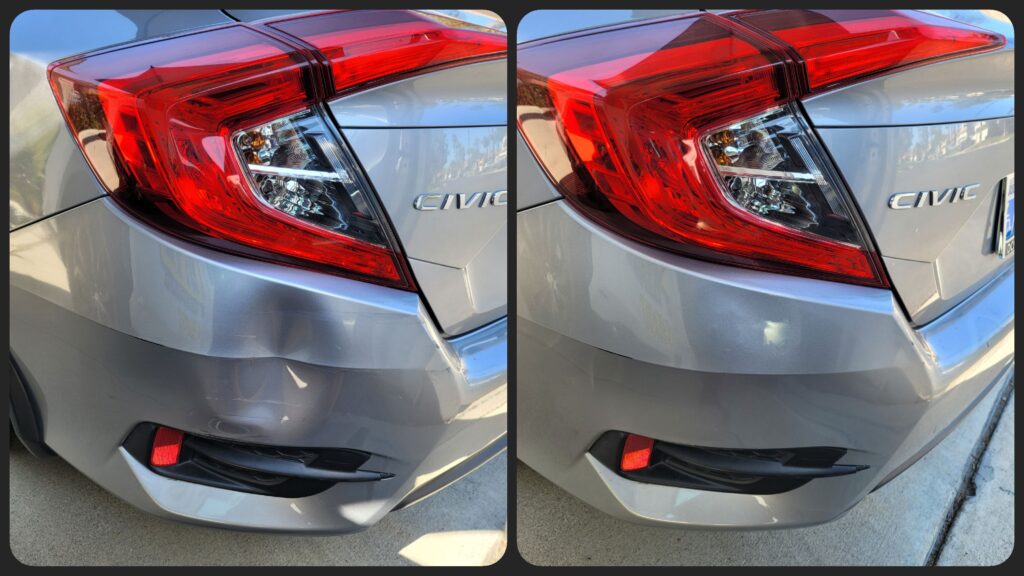
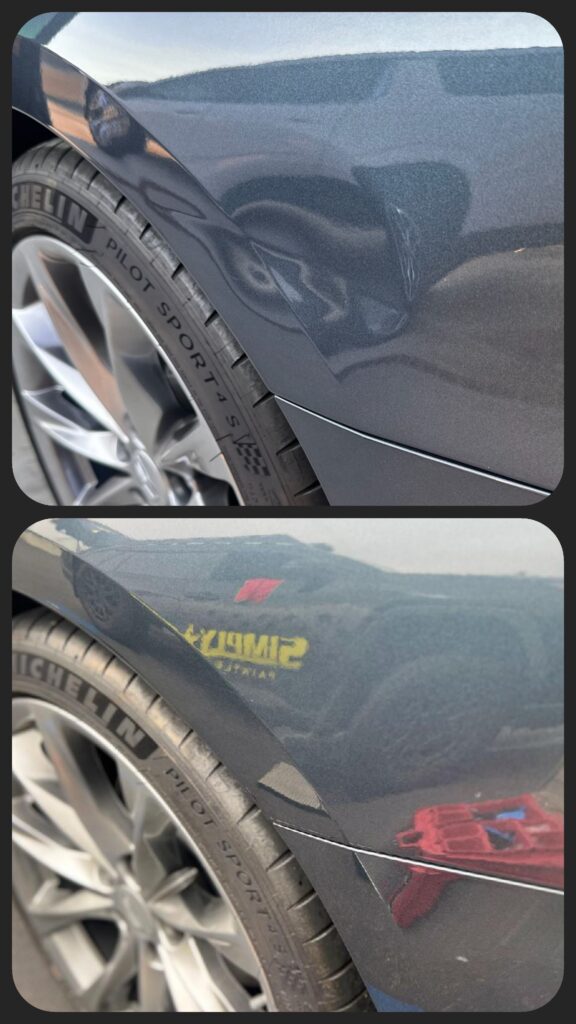
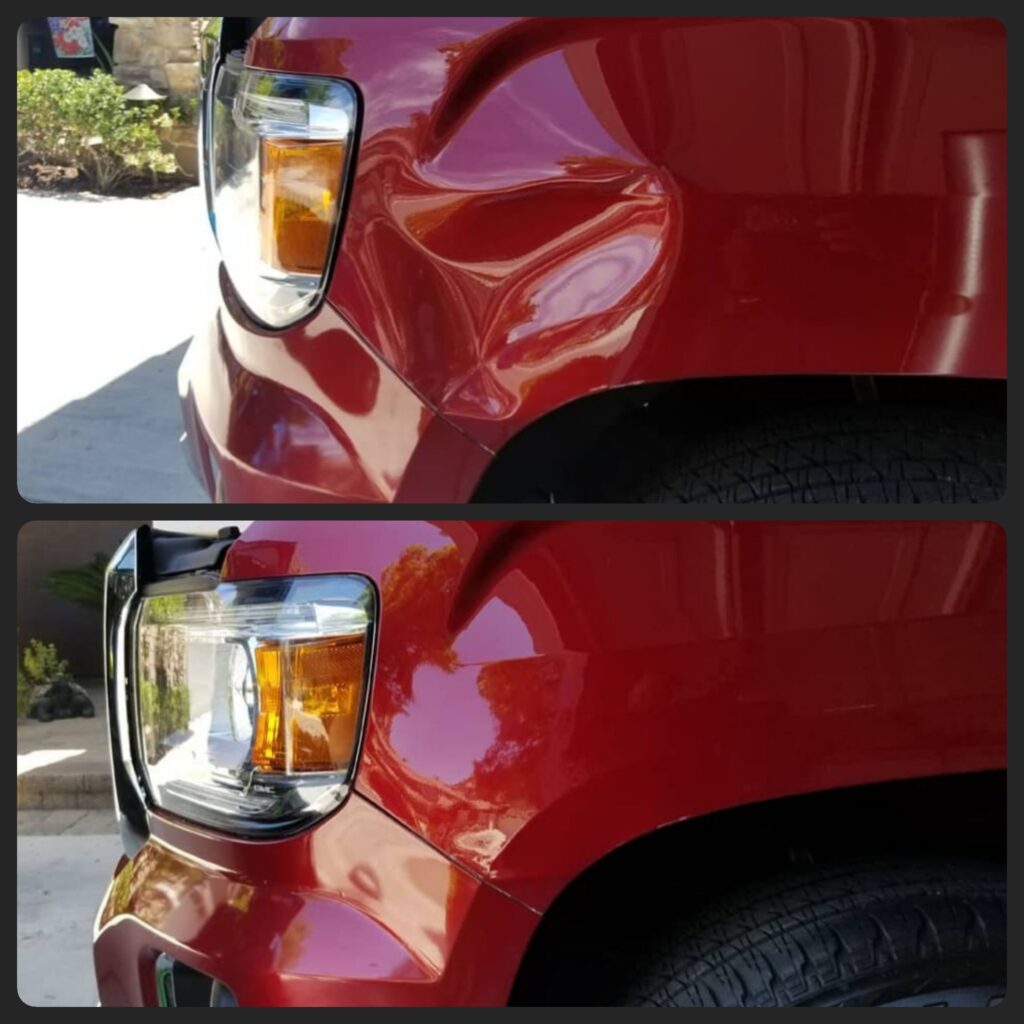
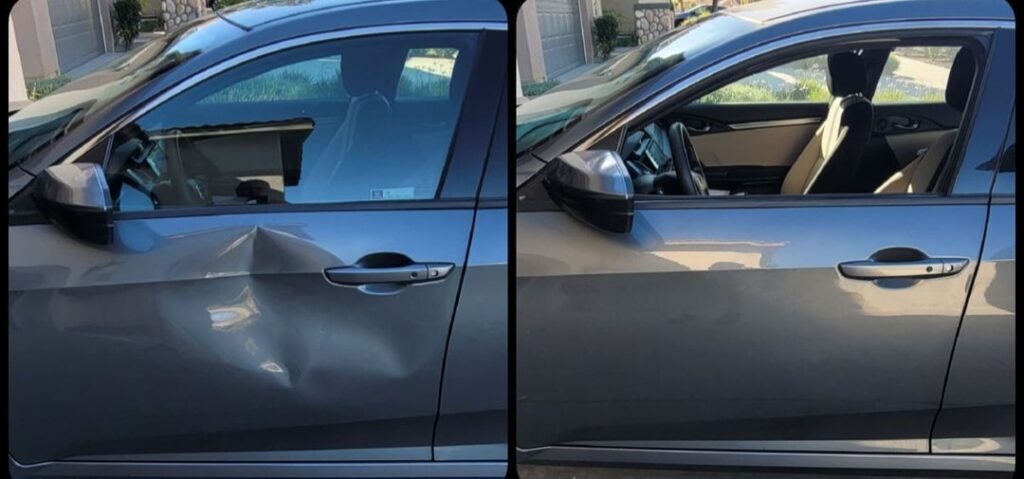
Both repair methods have an important place in automotive restoration. The right choice depends on the dent’s size, depth, location, paint condition, panel material, and severity. When the factory paint remains intact and the metal has not been damaged beyond recovery, paintless dent repair can often restore the panel without sanding, filler, primer, or repainting.
Understanding the differences can help you make an informed decision. For a professional evaluation, text photos of the damage to Simply Dents in Poway at 951.378.6662.
🔧 What Is Paintless Dent Repair?
Paintless dent repair, commonly called PDR, is a specialized process that restores damaged automotive metal while preserving the original paint.
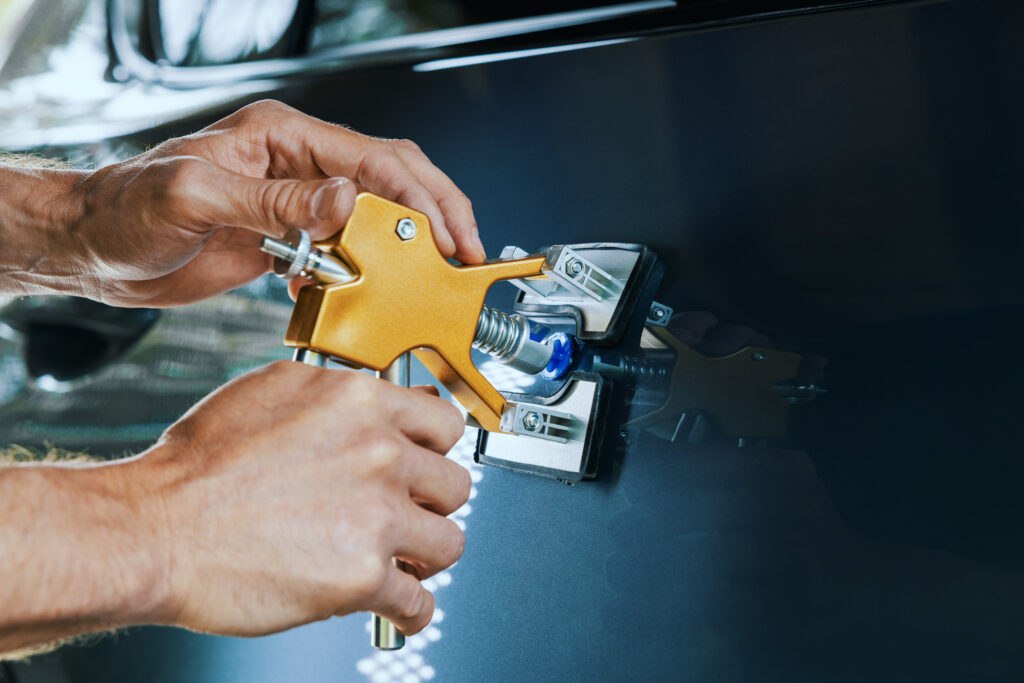
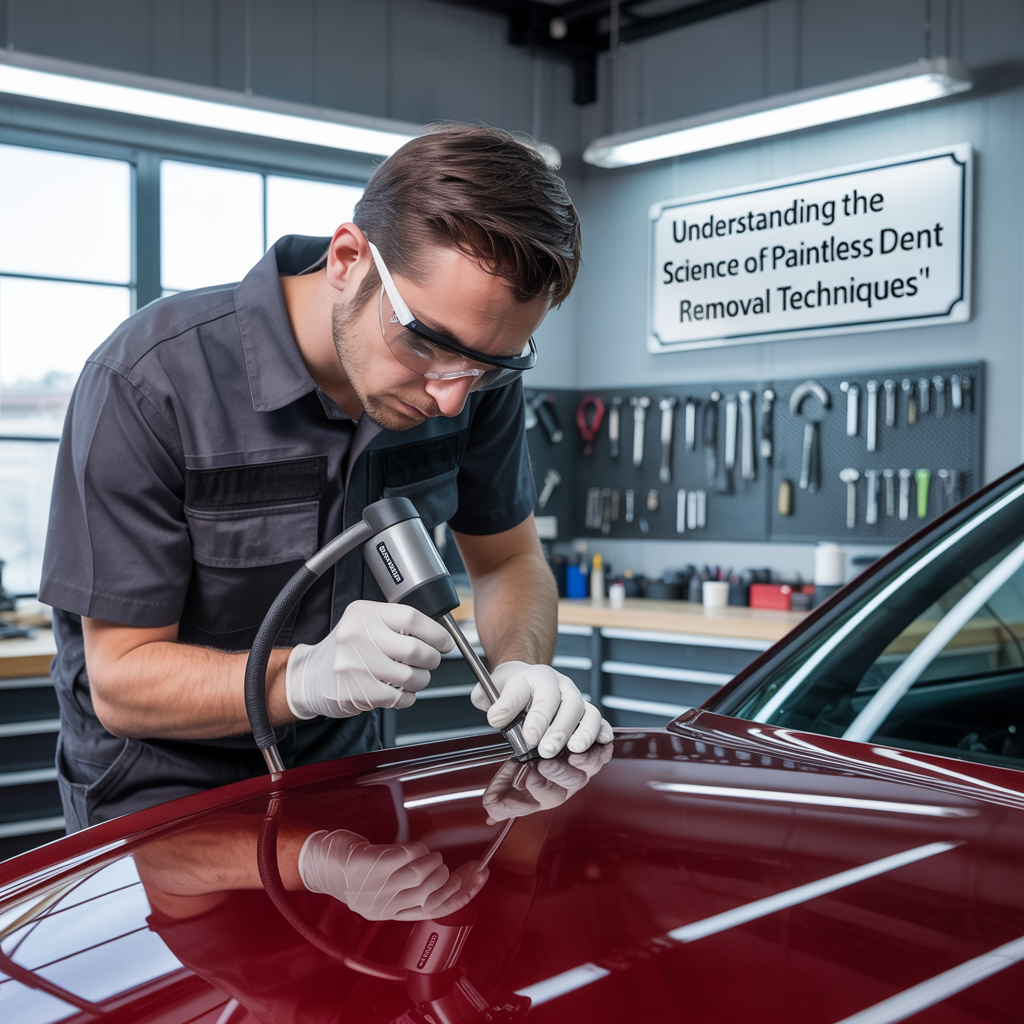
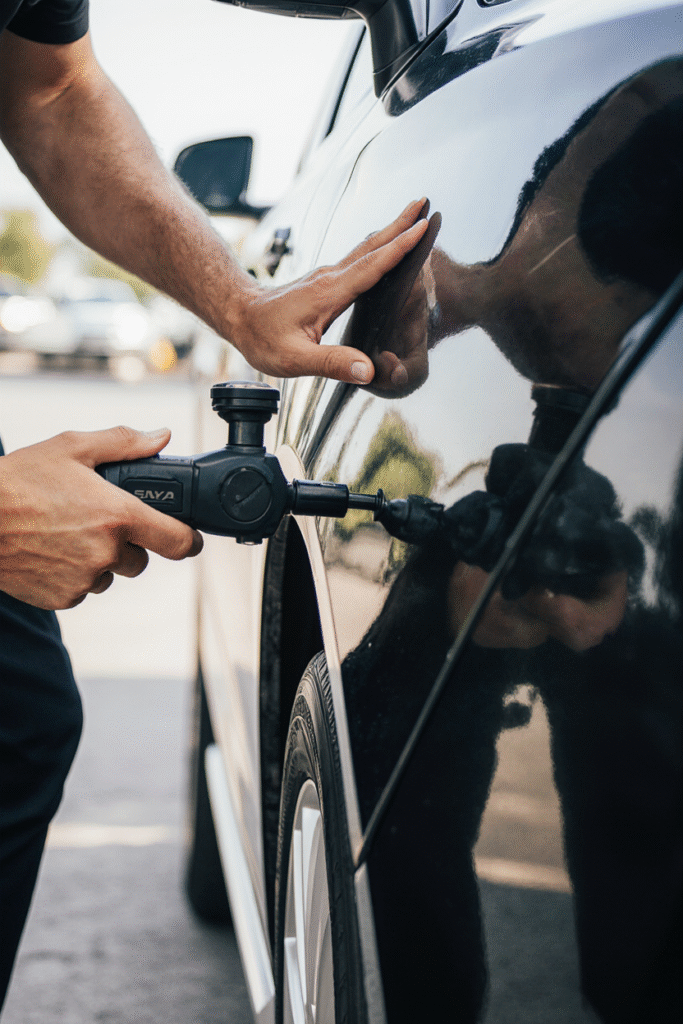
A trained technician uses precision tools and controlled pressure to return the panel to its factory shape. Depending on the dent’s location, the technician may work from behind the panel with specialized rods or use professional glue-pulling techniques from the exterior.
Specialized reflection lighting reveals distortions that may be difficult to see under normal conditions. The technician studies these reflections while making small, controlled adjustments to the metal.
PDR does not involve simply pushing the center of a dent outward. The process addresses the low point, surrounding crowns, tension, body lines, and subtle high spots until the panel’s natural contour is restored.
🎨 How Does a Traditional Body Shop Repair a Dent?
Traditional body repair is generally more invasive, but it is necessary for many types of severe damage. The process varies depending on the vehicle and extent of the damage.
Conventional repair may involve:
- Removing damaged trim or components
- Pulling or reshaping the panel
- Grinding or sanding the damaged surface
- Applying body filler
- Sanding the filler to recreate the panel’s contour
- Applying primer
- Matching the vehicle’s paint color
- Spraying new basecoat and clear coat
- Blending paint into an adjacent panel
- Curing, polishing, and reassembling the vehicle
This method can repair dents accompanied by cracked paint, torn metal, corrosion, severe stretching, or structural damage. It can also restore panels that must be replaced entirely.
The tradeoff is that the original finish in the repair area is removed or covered with refinishing materials.
📊 PDR vs. Body Shop at a Glance
| Consideration | Paintless Dent Repair | Traditional Body Shop |
|---|---|---|
| Factory paint | Preserved | Damaged area is generally repainted |
| Body filler | Usually unnecessary | Frequently used |
| Sanding | Not required on qualified dents | Usually required |
| Color matching | Not needed | Required |
| Repair time | Often same-day | May take several days |
| Best applications | Dents with intact paint | Severe damage or broken paint |
| Repair location | Mobile service may be available | Usually requires shop drop-off |
| Vehicle history | Original finish remains intact | Repaint may be detectable |
| Environmental materials | Fewer refinishing products | Paint, primer, filler, and solvents |
| Structural repair | Not intended for structural damage | Available for appropriate repairs |
The correct method depends on the damage rather than personal preference alone.
✨ Factory Paint Preservation
The biggest advantage of PDR is its ability to preserve the vehicle’s original factory paint.
Factory finishes are applied under highly controlled manufacturing conditions. Although a qualified body shop can produce excellent results, refinishing introduces new materials and requires color matching.
Maintaining factory paint helps avoid:
- Color-matching differences
- Overspray
- Sanding marks
- Body filler
- Paint-blending lines
- Differences in clear-coat texture
- Changes in paint thickness
Factory paint preservation can be particularly important for newer, luxury, classic, collector, leased, or high-value vehicles.
Traditional repair remains necessary when the original paint is cracked, deeply scratched, peeling, or missing. PDR cannot restore paint that has already been destroyed.
⏱️ Repair Time and Convenience
A traditional repair may require the vehicle to remain at a body shop for several days. Severe collision work can take longer, particularly when replacement parts, extensive disassembly, insurance approvals, or paint-curing time are involved.
PDR eliminates several conventional repair stages, including:
- Filler application
- Repeated sanding
- Priming
- Color matching
- Painting
- Clear coating
- Drying or curing
A typical door ding may be completed in less than an hour. Larger dents and creases can require several hours, while extensive hail damage may take one or more days.
Simply Dents offers mobile paintless dent repair in Poway, allowing many qualified dents to be repaired at the customer’s home or workplace. Call or text 951.378.6662 to discuss your vehicle.
💰 Comparing Repair Costs
Paintless dent repair can frequently cost less than conventional bodywork because it requires fewer materials and less labor. There is no need to purchase paint, primer, body filler, masking materials, or replacement trim for many PDR repairs.
Cost depends on:
- Dent size
- Dent depth
- Panel location
- Tool access
- Steel or aluminum construction
- Body-line involvement
- Number of dents
- Amount of metal stretching
- Required disassembly
- Previous repair work
A small, accessible door ding may be relatively economical. A sharp crease across a reinforced aluminum body line requires more time and expertise.
Traditional bodywork becomes more expensive when repairs require panel replacement, paint blending, extensive disassembly, or structural correction. Rental-car costs and several days without the vehicle may also affect the total expense.
PDR is not automatically the cheapest option for every dent, but it often provides excellent value when the damage qualifies.
🚙 What Damage Is Best for PDR?
Paintless dent repair is often appropriate for:
- Door dings
- Shopping-cart dents
- Hail damage
- Shallow parking-lot dents
- Minor collision dents
- Body-line dents
- Creases with intact paint
- Hood and roof dents
- Fender damage
- Quarter-panel dents
- Truck-bedside damage
- Steel and aluminum panels
A dent does not have to be tiny to qualify. A wide, shallow dent may be an excellent PDR candidate, while a small but extremely sharp impact may be more difficult.
Depth, location, metal condition, paint flexibility, and access are frequently more important than the dent’s diameter.
🏗️ When Is a Traditional Body Shop the Better Choice?
A conventional body shop is usually the correct option when the damage involves:
- Cracked or missing paint
- Deep scratches through the finish
- Torn or punctured metal
- Severe panel distortion
- Extensive metal stretching
- Rust or corrosion
- Structural damage
- Broken parts
- Damaged frames or unibody components
- Panels requiring replacement
- Safety-system damage
- Large collision repairs
PDR is primarily a cosmetic metal-restoration technique. It is not a substitute for structural collision repair or mechanical service.
An experienced technician should be willing to explain when paintless repair is unsuitable. If your damage requires traditional repair, that recommendation protects both the vehicle and the quality of the final result.
📈 How Each Option Can Affect Resale Value
Visible dents can reduce trade-in offers and make a vehicle more difficult to sell. Correcting cosmetic damage before a sale, appraisal, trade-in, or lease return may improve the vehicle’s appearance and perceived condition.
PDR offers a particular resale advantage because it preserves the factory paint. Dealers and vehicle appraisers may use paint-depth meters to identify repainted panels. Even high-quality refinishing can create a measurable difference in paint thickness.
Because PDR does not add primer, filler, basecoat, or clear coat, the repaired area retains its original paint thickness.
Traditional repair may still improve value when the alternative is leaving major damage unrepaired. A professionally refinished panel is much better than a torn, rusting, or severely damaged one. However, when both methods are possible, preserving the factory finish is often preferable.
🌎 Materials and Environmental Impact
Paintless dent repair generally uses fewer refinishing materials than traditional bodywork.
PDR typically avoids:
- Body filler
- Primer
- Basecoat
- Clear coat
- Paint thinner
- Extensive masking materials
- Sanding dust
- Replacement panels
Traditional collision repair facilities use equipment and procedures designed to manage these materials responsibly. Nevertheless, a qualified PDR repair can restore a dent using fewer consumable products.
For vehicle owners seeking a less invasive repair, this can be another meaningful benefit.
🏠 Mobile Service vs. Shop Drop-Off
Traditional bodywork requires a controlled repair environment. Sanding, painting, curing, structural repair, and panel replacement generally must be completed inside a properly equipped facility.
Paintless dent repair can often be performed as a mobile service. The technician brings specialized lights, rods, glue-pulling equipment, and other tools to the customer.
Mobile service may offer:
- Repair at your home
- Service at your workplace
- Less interruption to your schedule
- No shop drop-off
- No rental vehicle for many repairs
- Direct communication with the technician
- Same-day completion
The work location must have reasonable access, adequate lighting, and a safe operating area. Weather and the complexity of the repair may also affect where the service can be performed.
🌨️ Which Option Is Better for Hail Damage?
Paintless dent repair is frequently the preferred method for automotive hail damage when the paint remains intact. A hailstorm may leave dozens or hundreds of dents across the roof, hood, trunk, fenders, and body panels.
Traditional repair might require refinishing multiple panels. PDR allows technicians to address the dents individually while maintaining the factory finish.
However, conventional repair may be required when hail has:
- Cracked the paint
- Broken glass
- Damaged trim
- Created extremely sharp impacts
- Severely stretched the metal
- Damaged a panel beyond practical restoration
Hail damage may be covered under comprehensive auto insurance, depending on the policy. Always review your coverage and obtain a complete vehicle inspection.
🛻 What About Trucks and Aluminum Panels?
PDR can be performed on both steel and aluminum panels. Aluminum behaves differently and can be less forgiving, so it often requires additional experience and specialized techniques.
Paintless repair may be suitable for:
- Aluminum hoods
- Aluminum doors
- Truck bedsides
- Tailgates
- Dually fenders
- SUV panels
- Luxury vehicles
- RV and toy-hauler panels
A technician must evaluate the dent’s depth, panel construction, paint condition, internal bracing, and available access.
Traditional body repair may be necessary when the aluminum is torn, sharply folded, extensively stretched, or accompanied by significant paint damage.
🧲 What Is Glue-Pull Repair?
When the back of a dent cannot be accessed, a PDR technician may use glue-pull repair. Special tabs are temporarily attached to the exterior surface and used to apply controlled pulling force.
The technician may alternate between lifting low areas and gently reducing high spots until the panel is restored.
Glue pulling can be useful for certain:
- Roof dents
- Braced panels
- Quarter panels
- Rails
- Hail damage
- Areas with limited rear access
The process must be performed carefully. It may not be appropriate on panels with loose, damaged, or uncertain aftermarket paint.
🚩 Questions to Ask Before Choosing a Repair Method
Before authorizing repairs, ask:
- Is the factory paint intact?
- Has the metal been severely stretched?
- Is the dent accessible from behind?
- Does the damage cross a body line?
- Is the panel made from steel or aluminum?
- Has the panel been repaired or repainted previously?
- How long will the repair take?
- Will filler or repainting be required?
- Can the repair be completed at my location?
- What results can I realistically expect?
Clear answers can help you compare the methods based on your actual vehicle rather than general assumptions.
📸 How to Get a PDR Evaluation
The easiest way to begin is to send clear photos of the damaged area.
For useful estimate photos:
- Clean the panel.
- Use bright, indirect lighting.
- Take one image from several feet away.
- Include a close view of the dent.
- Photograph the damage from multiple angles.
- Show nearby panel edges and body lines.
- Include any chipped, scratched, or cracked paint.
- Avoid sending only an extreme close-up.
Text the photos to Simply Dents at 951.378.6662. An in-person inspection may still be needed to confirm access, metal condition, and repairability.
✅ Which Repair Option Should You Choose?
Choose paintless dent repair when:
- The paint remains intact.
- The panel can be reshaped safely.
- You want to preserve the factory finish.
- The damage is cosmetic rather than structural.
- The dent is accessible using PDR techniques.
- You want a potentially faster, mobile repair.
Choose a traditional body shop when:
- The paint is badly damaged.
- The metal is torn or severely stretched.
- Structural components are affected.
- A panel needs replacement.
- Significant collision or mechanical damage is present.
- Repainting is necessary for a complete restoration.
The right answer is the method that produces a safe, durable, and visually appropriate result for the specific damage.
📞 Schedule Mobile Paintless Dent Repair in Poway
When a dent qualifies for PDR, you may be able to restore your vehicle without sanding, body filler, or repainting. The process can preserve factory paint, reduce repair time, and eliminate the need for an extended body-shop stay.
Text photos to 951.378.6662 today for an evaluation. Simply Dents can help determine whether PDR is appropriate or whether your vehicle would be better served by a traditional body shop.